
Behind the Mask: Spider-Man’s Identity
Written By: Alaina Yan
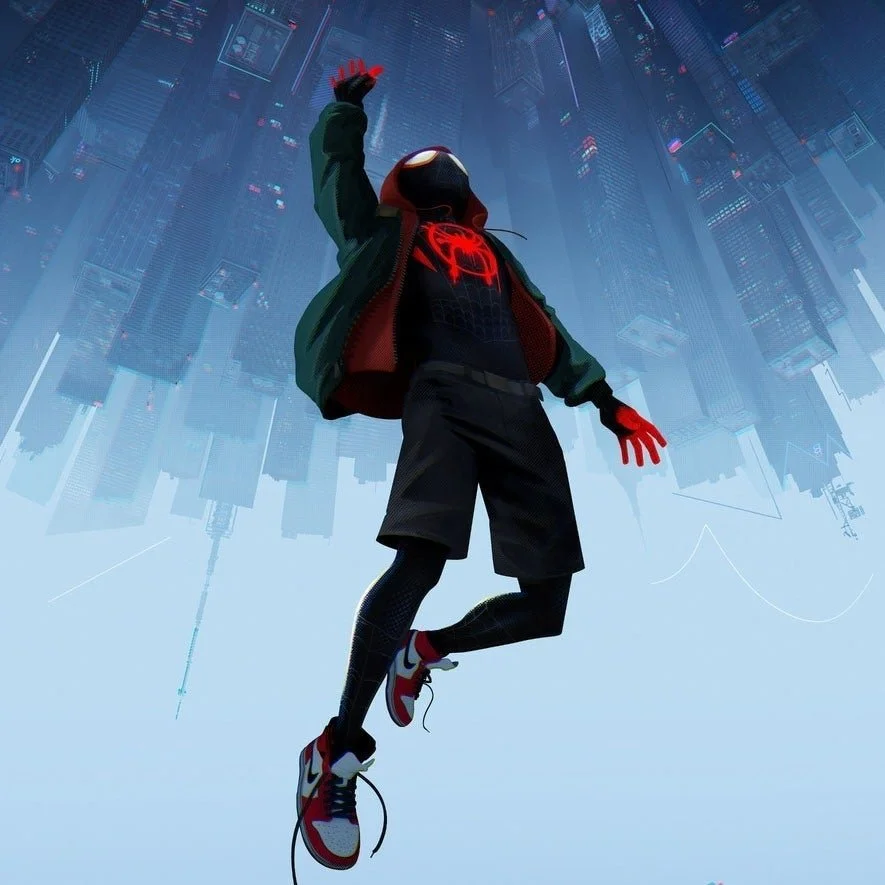
Credits to Sony Pictures
Spider-Man is one of the most well-known characters in comic book history; hundreds of thousands of movie and book adaptations have been created. While many adaptations are monotonous, following an experienced hero fighting off supernatural enemies, others break out of the mold by using Spider-Man as a canvas to explore deeper, more realistic topics. For example, the creation of Rodney Rothman and Phil Lord’s Spider-Man: Into the Spiderverse aimed to bring a fresh face and a new perspective to the Spider-Man brand. Therefore, Rothman and Lord utilize Miles Morales, a young Afro-Puerto Rican teenager, to relate to teenagers' struggles with self-identity. Miles Morales’s journey to becoming a hero in Spider-Man: Into the Spiderverse explores that individualism is developed by embracing one’s authenticity.
In Spider-Man: Into the Spiderverse, Miles uses urban art to express his creativity, marking him as a unique individual. Whenever he has time, Miles meets with Uncle Aaron in an abandoned subway station to spray paint despite his dad’s distaste for graffitis. In Isabella Giordano’s journeys.dartmouth article, she analyzes how “in the beginning, Miles’ teacher asks him to write a personal essay answering, ‘what kind of person do you want to be.’ Miles struggles, ultimately leaving the paper blank…However, by the end of the film, he is able to finish the essay in his own artistic style [with graffiti comic-book art]” (The Power of Form 2). Miles, although artistically talented, hides his skills in favor of conforming to the expected black-and-white printed personal statements. His unique, colored paper represents his development and embracement of his “own artistic style.” Another example of Miles embracing his art style is when he redesigns his Spider-Man suit black and red. In Blizzic’s video essay, Blizzic discusses how
the first two shots of the web-swinging sequence… stylishly calls attention to the graffiti Spider-Man logo on Miles’s suit. It’s not just satisfying to see Miles in a suit, it’s satisfying because the suit is clearly his from top to bottom. The graffiti aesthetic that he spray-painted on, the Air-Jordan’s on his feet, the hoodie…the suit itself demonstrates that Miles is forging his own identity rather than failing to imitate the other spider[people]. (Mile’s Leap of Faith 16:03-16:34)
While Miles begins to change his mindset and cease his attempts to “imitate the other spider[people],” the black-and-red suit serves as a physical manifestation of his newfound acceptance of his individuality. The contrast between the stereotypical red and blue Spider-Man suit and Miles’s “graffiti aesthetic” suit with “Air-Jordan’s” and a “hoodie” further emphasizes how Miles is fully utilizing his unique art talent to create “his own identity,” effectively setting him apart from the other spider-people.
Miles’s growing confidence in himself contributes to his transformation into a steadfast character. After the first collider test trial brought five other super-powered spider-people onto Miles’s dimension, they work together to prevent Kingpin from ripping a hole in the multiverse. In a NarrativeFirst interview with the screenwriters of the movie, Jim, the interviewer, discusses the other spider-people’s impact on Miles:
“He doesn’t need Spiderman’s permission to be Spider-man, or his father’s…he
goes and does it. The spider[people] were all pointing out what he lacked, right? His deficiencies.” (Writer)
“So he forgot what everyone thinks of him, he’s gonna do it his own way.” (Jim) (Spider-Man: Into 7)

Feeling overshadowed and insignificant compared to the other experienced spider-people, Miles doubts his capability to be a hero and becomes irrationally afraid of making the wrong decision. However, as he “forgets what everyone thinks of him,” he begins to understand that, although he is not the typical, courageous, and nearly flawless Spider-Man people expect, he is still capable of achieving the same feats and completing the same good deeds. Rather than further suppress himself because of his “deficiencies,” he embraces and even draws from it to become the best, truest version of himself. Similarly, in a personal interview with Monica Lopez, a Spider-Man fanatic, she responded to Miles’s lack of confidence with, “I think he felt embarrassed. They are all professionals, they’re trained…and he’s just this kid from the Bronx, but after he realizes, oh, I’m also Spider-Man, not the side-kick the other spider-people think I am, he begins to lock in. He basically feels like an equal” (Lopez 8:24-8:40). Miles trusts the other spider-people over himself; he believes the more “professional” and experienced spider-people are superior and better suited to being Spider-Man than he could ever hope to be. Despite having equal powers, Miles’s lack of confidence leads him to subdue his uniqueness to try to fit into the expected role of “side-kick.” However, after realizing he also has an important role in defeating Kingpin, he builds confidence in his differences and uniqueness.
Mile’s debut and journey as Spider-Man in Spider-Man: Into the Spiderverse highlights that one must honor their authenticity to build an honest, unique identity. By spray painting his suit and decorating his personal essay with colorful mini-graffitis, Miles embraces his distinctive urban art style. Miles’s growing confidence in his abilities and eventual acceptance of his differences also contribute to his development into a confident, self-assured character. Spider-Man: Into the Spiderverse remains one of the greatest films in cinema through its extraordinary animation, engaging plot, and complex characters.
