
The Machine in Your Pocket
Written By: Yufei Wu
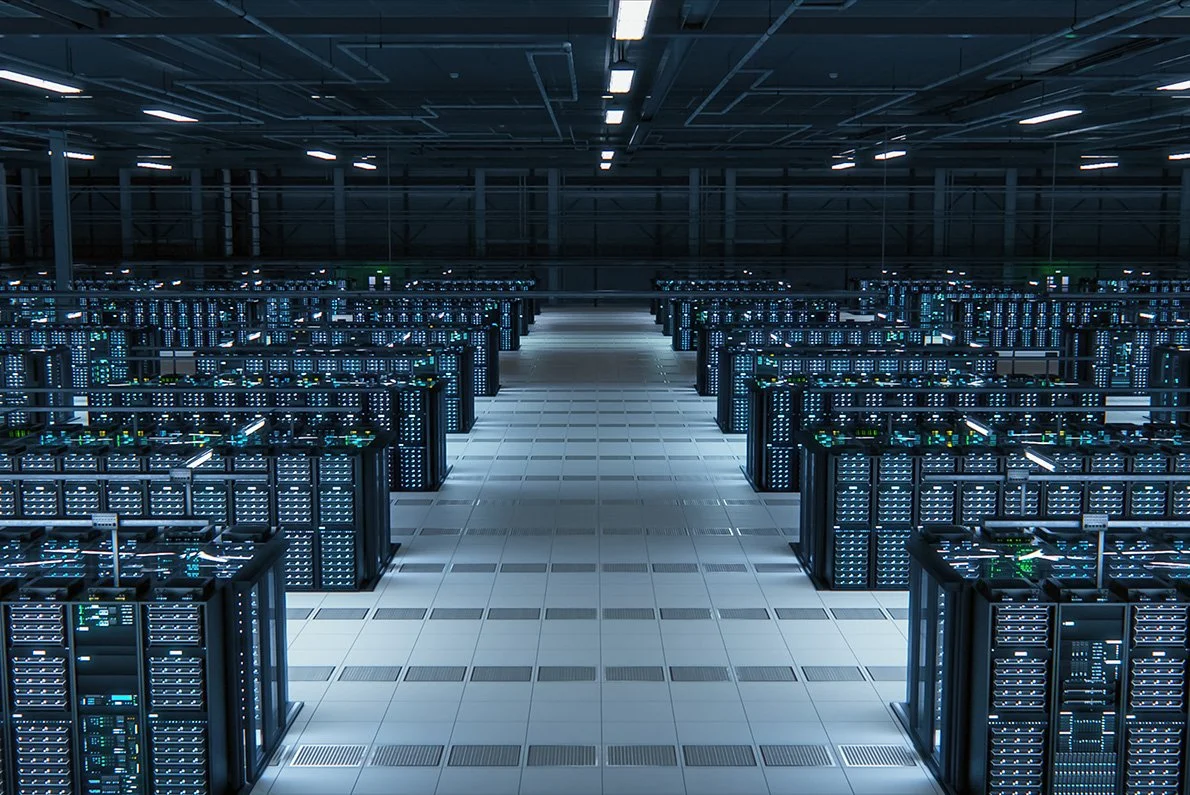
Image from Berkely Lab News Center
Artificial Intelligence. The term increasingly echoed through every corner of modern life. When we think of Artificial Intelligence, we imagine imposing, sophisticated models capable of possessing an almost mythic omniscience. We picture models like Gemini AI and ChatGPT that reside inside our phones, lying dormant until they receive the next prompt, the next directive for execution. Yet a paradox emerges: how do these computational giants fit within the narrow confines of a smartphone? To put it simply, they don’t; they lie in warehouses, in data centers filled with humming servers that might be hundreds of miles away.
This vast, invisible network of remote servers is what is often known as “cloud computing.” In this framework, every query we ask embarks on a journey. Every bit of data is captured, packaged, and shipped across oceans and mountains via underground fiber-optic cables to centralized server farms in milliseconds. There, thousands of processors collaborate to draft a response before flashing it right back to our screen. But this invisible commute carries three hidden tolls. The first is energy; these data centers devour electricity, and training a single large model can exhale as much carbon as several cars do in a year. The second is time; that round trip explains the awkward pause before your AI agent starts to reply. The third, and perhaps most personal, is privacy; for the machine to understand you, your data must first leave you, surrendered to whoever waits on the other end.
But it need not be this way. What if, instead of sending our data on a pilgrimage, we brought the AI home to our data? This is the promise of a quiet revolution called “edge computing,” or running AI directly on the device so that nothing must travel anywhere at all. In theory, such a shift would eliminate all three tolls at once: without the round-trip, it conserves more energy and eliminates the awkward pause one has to wait for a response. As the data is now never passed through the internet, privacy returns to its rightful owner. However, the catch of this idealized strategy is, of course, scale. The brains behind modern AI are computational giants, hungry for memory and power. Their knowledge lives in billions of numerical values, each one a tiny dial tuned during training, and every dial demands space to store and energy to consult. Shrinking them down to fit inside a pocket-sized machine is no trivial feat. And so the challenge becomes a delicate negotiation. How much can we compress, prune, and simplify a model before it forgets how to be intelligent at all? Essentially, it is the digital equivalent of squeezing a sprawling library into a single closet. It is part engineering, part detective work, and part ongoing quest — a frontier that researchers across the world are still actively striving to conquer.
Ultimately, edge computing promises to reclaim something we have quietly surrendered: our digital independence. A world of on-device intelligence is a fundamentally different world from the one we inhabit now. Imagine your phone or car now capable of running AI without ever reaching for the internet. Your data is now its own, its answers instant, its appetite for power small. Perhaps the future of artificial intelligence is not the large data centers people once envisioned, but their opposite, of small, quiet machines, each thinking for itself.
