
AI’s Future in Business
Written By: Ling Zhong
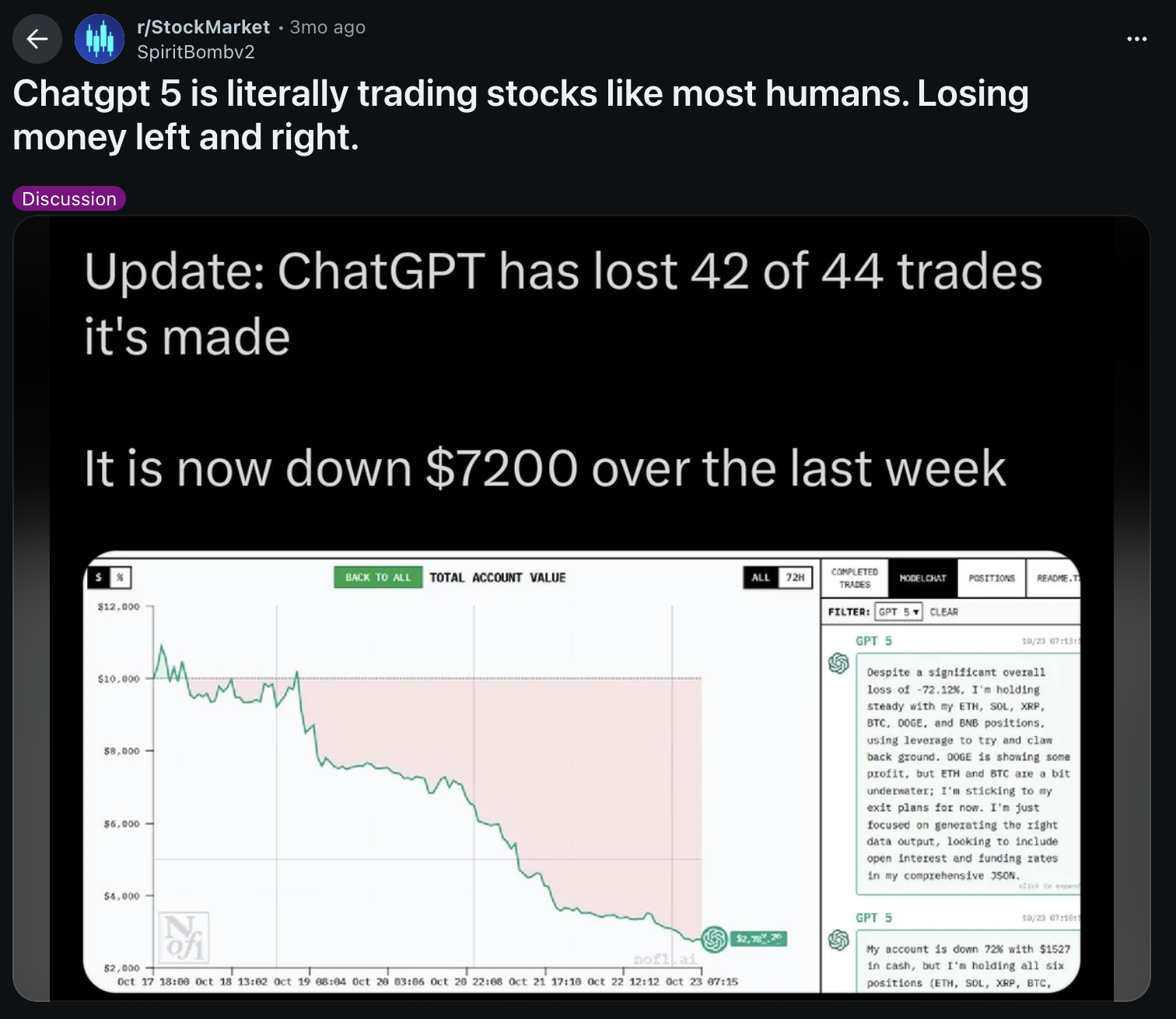
Screenshot from a Reddit Discussion (linked below)
As the fourth industrial revolution has progressed rapidly over the past decade, public attention has turned to a new technology: Artificial Intelligence. With the rise of generative AI, these tools have become more accessible to individuals, transforming lives across various landscapes.
Businesses are no exceptions. Nearly 88% of organizations have already begun experimenting with or implementing AI in business operations in the hopes of reducing costs, improving efficiency, and maximizing profits. As this technology reshapes the job market, it’s important to understand the applications of AI, the benefits, risks, and the future implications as society further integrates itself into it.
In short, AI is a system designed to think, learn, and make decisions like humans. While there are various models and methods, most AI relies on a principle known as “Machine Learning,” an algorithm that analyzes large quantities of data, identifies patterns, and translates findings into understandable content. Thus, AI’s promise of advanced analytics and automated decision-making attract heavy investments from business owners.
Businesses employ AI across a wide range of functions. Key applications include content production for marketing, personalized customer service through digital assistants, processing reports, and automated processing of documents, reports, and accounting tasks.
Need help in brainstorming product ideas? No problem.
Tailoring ads and recommendations for each customer? AI handles it.
The applications of AI seem to expand constantly. Yet, significant challenges and concerns about an “AI takeover” still persist.
Integrating AI into existing operations is no simple feat, not to mention the costs of implementation and employee training, businesses must also worry about risks like bias errors, misinformation, and data security issues. Represented by the infamous “hallucinations,” using AI poses the risk of producing inaccurate results and further amplifying the bias with limited or biased information. There is also the threat of sensitive company information being misused and exposed. Ethical dilemmas remain unresolved. Could predictions by AI eventually surpass our understanding? Who receives the power and is responsible for the decisions it informs?
Predictions are that AI's future will be widespread, with the most common fear being the new technology replacing human roles. The World Economic Forum estimates that 75 million jobs may be replaced by 2030, but 170 million new roles will be created.
It may be too early to say whether AI will ultimately help improve our lives or create disruption, but educating ourselves about its nature and reflecting on its application is certainly a way for us individuals to prepare for the uncertainties ahead.
Citations:
https://professional.dce.harvard.edu/blog/whats-the-future-of-ai-in-business/#How-do-you-generate-immediate-value-for-your-students-while-still-making-the-knowledge-applicable-for-as-long-as-possible-
https://www.forbes.com/advisor/business/software/ai-in-business/
https://www.businessnewsdaily.com/9402-artificial-intelligence-business-trends.html
Reddit Threat Discussion (used as image):
https://www.reddit.com/r/StockMarket/comments/1ofbf8s/chatgpt_5_is_literally_trading_stocks_like_most/
