
10,000 Apples: Death and Pleasure
Written By: Jayden Zhang
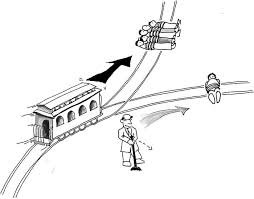
Image from PoliLegal
I recently attended a rather prestigious debate competition, and the one word that I must use to describe it is “pretentious”. Quite a lot of times, debaters will try to make the topic as convoluted as possible, (a la kritik) and there are two main reasons for this. The first thought is that they genuinely believe that the debate requires higher-level argument (most do not). Secondly, and much more likely, is that they simply want to achieve an easy win by “killshotting” less experienced teams. However, there was one topic during the tournament that required a much more complicated thought process than simply weighing good and bad, and I think it provoked an interesting discussion on ethics overall. The exact details of the round aren’t that important, but in short, it compared utilitarianism to moral guidance. Although I won’t be going into morals very much in this essay, I will be delving into utilitarianism, and to begin we must define the term.
Quite a lot of debate rounds, as well as many decisions in real life, are based off of the ethical framework known utilitarianism, us debaters posit it simply as “the most amount of good for the most amount of people.” Prima facie, it seems rather simple, giving someone food is better than taking away food. In many cases, this is quite enough. Placing a hospital in the middle of a city might displace some, but the overall benefit of having an easily accessible treatment facility outweighs the negatives. However, this idea falls apart rather quickly when we think in-depth of it.
To begin, let’s introduce a thought experiment called the “utility monster”. Imagine a hypothetical world where some people, let’s say around ten-thousand, have an apple. Then, we introduce a hypothetical creature who REALLY enjoys apples. To the point where it outweighs everyone else’s enjoyment for apples. By utilitarianism, it would be justified to take all the apples from others and give them to the monster, simply because he would reap more gain from them. It doesn’t matter that nine-thousand nine-hundred ninety-ninety people do not have apples, as long as the monster’s enjoyment is more than the anguish of everyone else. That brings us to the major problem with utilitarianism, the fact that it is inherently assigning numerical and quantitative values to, as well as systemically calculating, abstract ideas.
Under a utilitarian worldview, all misfortunes are measured under the same scale. Death is measured on the same numerical scale as losing an apple, as large as the number may be. What that means is that theoretically, there would be a point where death would be as appalling, or even less appalling, than losing a large number of apples. While food and drink is necessary for human survival, an excess of it becomes nothing more than hedonism. It is impossible to draw the line between need and want, and it is unwise to weigh them on the same scale.
The other problem is that these issues not only intrinsically differ from one another, but they can also differ from themselves on cultural values. In some places, death is viewed more as a transition to the afterlife rather than a loss. In this case, would one death be viewed as less important than others? Would a certain amount of these deaths be equivalent to another? Utilitarianism dehumanizes human suffering and joy, treating it as more of an asset or a statistic rather than an emotion to be felt. Utilitarianism forces an objective worldview onto issues that are inherently subjective.
Finally, utilitarianism simply is impossible. For maximum “good” (if such a definition existed), the actor would essentially need to see into the future. It is impossible for us, as of right now, to know exactly what results an action could lead to in the long run. Each decision made has countless consequences that must be considered all at once in order for an effective decision to be made, and that is unfeasible and inefficient.
So how should the world be viewed? The answer is that I don’t know. As humans, we continually try to make sense of the world around us, and the idea of utilitarianism is just another hypothesis. Even if I don’t believe in it, there are many that do, and such our conversation fades once again into the ethereal realm of subjectivity.
